
VFFS vs. HFFS: How to Choose the Right Packaging Machine for Your Production Line
Introduction: The High-Stakes Decision of Packaging Machinery
Selecting the right packaging machinery is undoubtedly one of the most critical capital expenditure decisions for any manufacturing facility operating in today’s fiercely competitive environment. When a production line is equipped with a misaligned packaging system, the consequences ripple across the entire operation. It leads to crippling production bottlenecks, excessive and costly film waste, and worst of all, delayed shipments that damage distributor relationships and bottom-line revenue. For factory owners, procurement directors, and production managers traversing the complex industrial landscape of Bangladesh, the stakes are even higher.
The manufacturing sector in Bangladesh, spanning food, pharmaceuticals, and fast-moving consumer goods (FMCG), operates on tight margins and demanding volume requirements. In this context, understanding the deeply structural and nuanced operational differences between Vertical Form Fill Seal (VFFS) and Horizontal Form Fill Seal (HFFS) machines is not just a technical necessity—it is the foundational step toward scaling your factory efficiently and profitably.
This comprehensive guide breaks down everything from mechanical mechanics to return on investment (ROI), designed specifically to help B2B decision-makers bypass generic advice and make a high-level strategic choice.
The Manufacturing Landscape in Bangladesh: Speed, Space, and Uptime
Before diving into the mechanical disparities between VFFS and HFFS platforms, it is crucial to analyze the specific pressures faced by Bangladeshi manufacturing facilities. Industrial real estate, particularly in optimized economic zones or near major transit arteries in Dhaka and Chattogram, commands premium pricing. Therefore, optimizing the output per square meter is a top priority for factory directors.
Furthermore, Bangladesh’s vibrant food and beverage industry—producing everything from powdered spices and wheat flour to potato chips and individually wrapped snacks—requires machinery that can pivot quickly between different product lines formats without enduring days of recalibration. You cannot afford to halt an entire factory floor because a machine’s film-pulling belt eroded or its sensory logic failed.
Global competitors like Nichrome, Pakona, or Rovema often offer robust systems, but they frequently come burdened with massive logistical hurdles. A factory owner in Bangladesh might wait six to eight months simply to navigate Letter of Credit (LC) approvals and secure international shipping. Once the machine arrives, the reliance on foreign engineers for installation and subsequent maintenance creates a severe vulnerability. If a specialized part fails, you are paralyzed waiting for international couriers.
This is where WIDEWAYS Techserve dramatically alters the paradigm. We understand that machinery is only as good as its uptime. Whether you decide a vertical or horizontal architecture suits your product best, sourcing locally—with access to German and Japanese precision—protects your factory from these devastating logistical delays.
Deep Dive: Vertical Form Fill Seal (VFFS) Mechanics
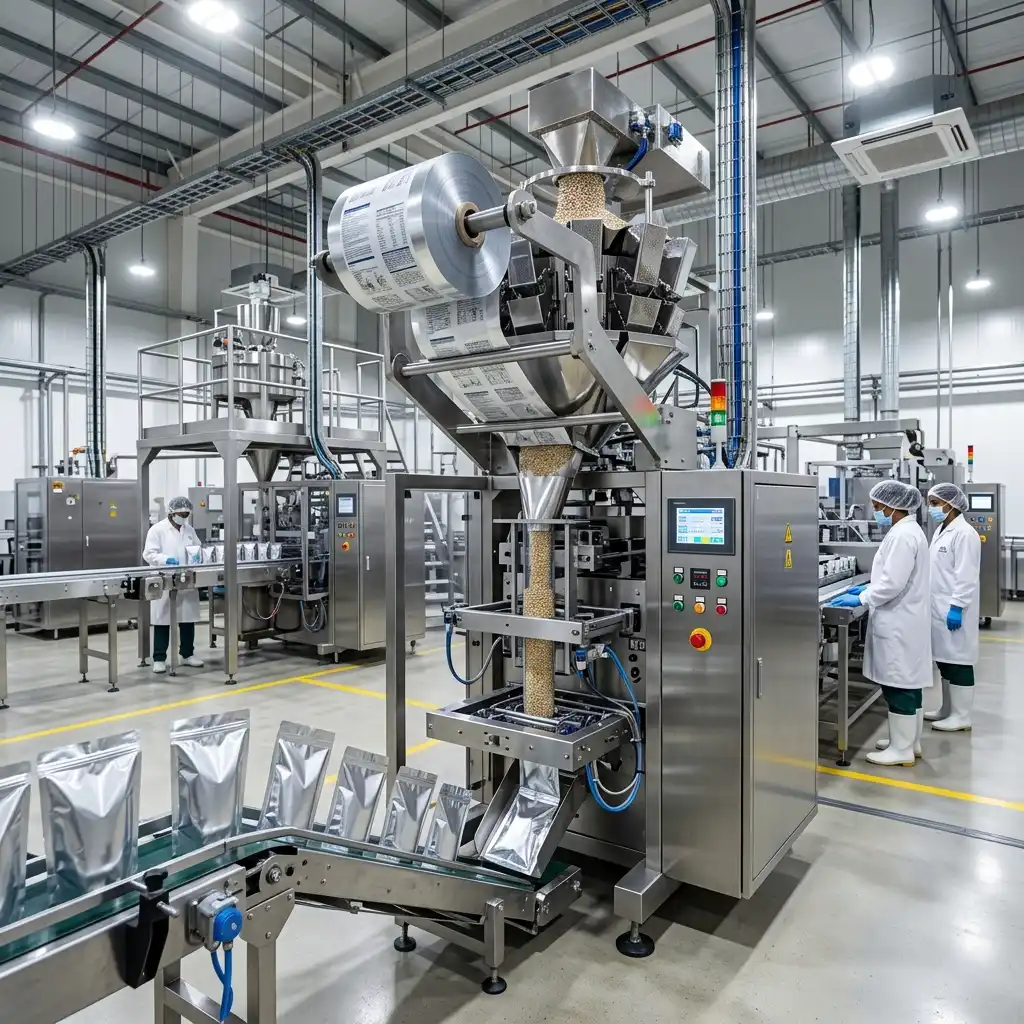
Vertical Form Fill Seal (VFFS) machines are the absolute workhorses of the modern packaging sector. As the name explicitly states, these machines operate on a vertical axis. They are engineered to utilize one of the most reliable forces in physics: gravity.
How VFFS Operates
The operational sequence of a VFFS machine begins with a massive roll of continuous packaging film located at the rear of the unit. A precisely calibrated motorized mechanism pulls the film upward and over a specialized “forming tube.” As the flat film wraps around this tube, it transforms into a continuous cylinder.
Next, vertical heating jaws apply intense, highly controlled heat to seal the overlapping edges of the film, creating the back-seal of the pouch. Simultaneously, horizontal heating jaws seal the bottom of the cylinder, creating an empty, open-topped bag. At this exact microsecond, the dosing system—whether it be a servo auger filler for spices or a multi-head weigh filler for potato chips—drops the meticulously measured product straight down the forming tube into the pouch. Finally, the horizontal jaws close again, sealing the top of the filled bag and simultaneously cutting it free.
Ideal Applications for VFFS
Because the product drops vertically, VFFS systems are overwhelmingly the superior choice for loose, granular, powdered, or highly fragmented products. If you are packaging items that naturally conform to the shape of their container when dropped, vertical machinery is the appropriate capital investment. Industrial examples include:
- Food & Beverage: Pulses, rice, sugar, whole grains, potato chips, snack mixes, and coffee beans.
- Powders: Turmeric, chili spice powder, wheat flour, baking powder, and nutritional supplements.
- Industrial/Agrochemical: Detergent powders, fertilizers, granular pesticides, and hardware components like screws.
Engineering Advantages of WIDEWAYS VFFS
A standard VFFS machine is fast, but a premium VFFS machine guarantees longevity. WIDEWAYS systems integrate advanced automation architectures from Beckhoff alongside robust Siemens Programmable Logic Controllers (PLCs). This means the operational logic—such as regulating the microsecond timing of the heating jaws relative to the film pull speed—is handled flawlessly. Furthermore, the entire superstructure is constructed entirely from high-grade SS304 stainless steel. This ensures unimpeachable hygiene standards that easily exceed strict regulatory compliances for the FMCG and pharmaceutical sectors.
Deep Dive: Horizontal Form Fill Seal (HFFS) Mechanics
If vertical machinery relies on gravity, Horizontal Form Fill Seal (HFFS) machinery relies on rigorous horizontal orientation and stability. HFFS machines are designed to move products horizontally down a lengthy conveyor system while the packaging film is formed, filled, and sealed around them.
How HFFS Operates
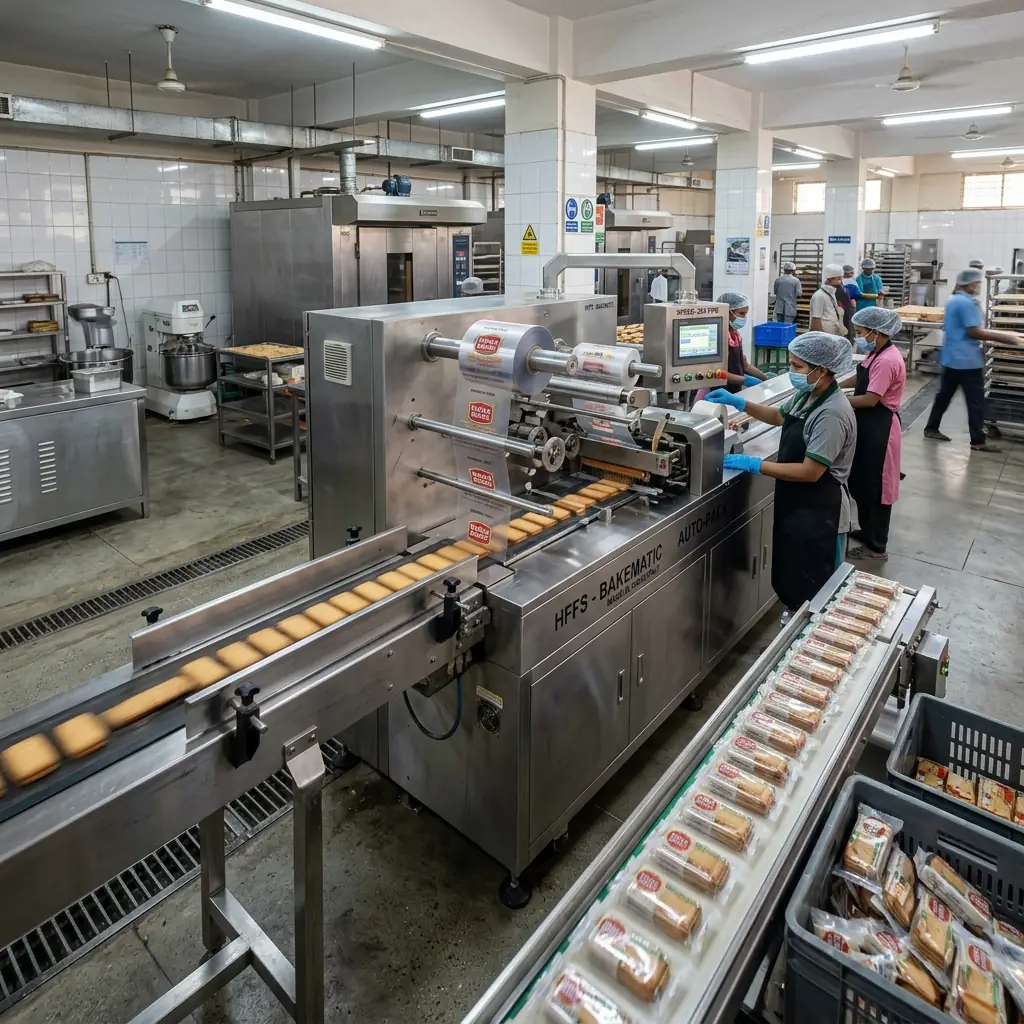
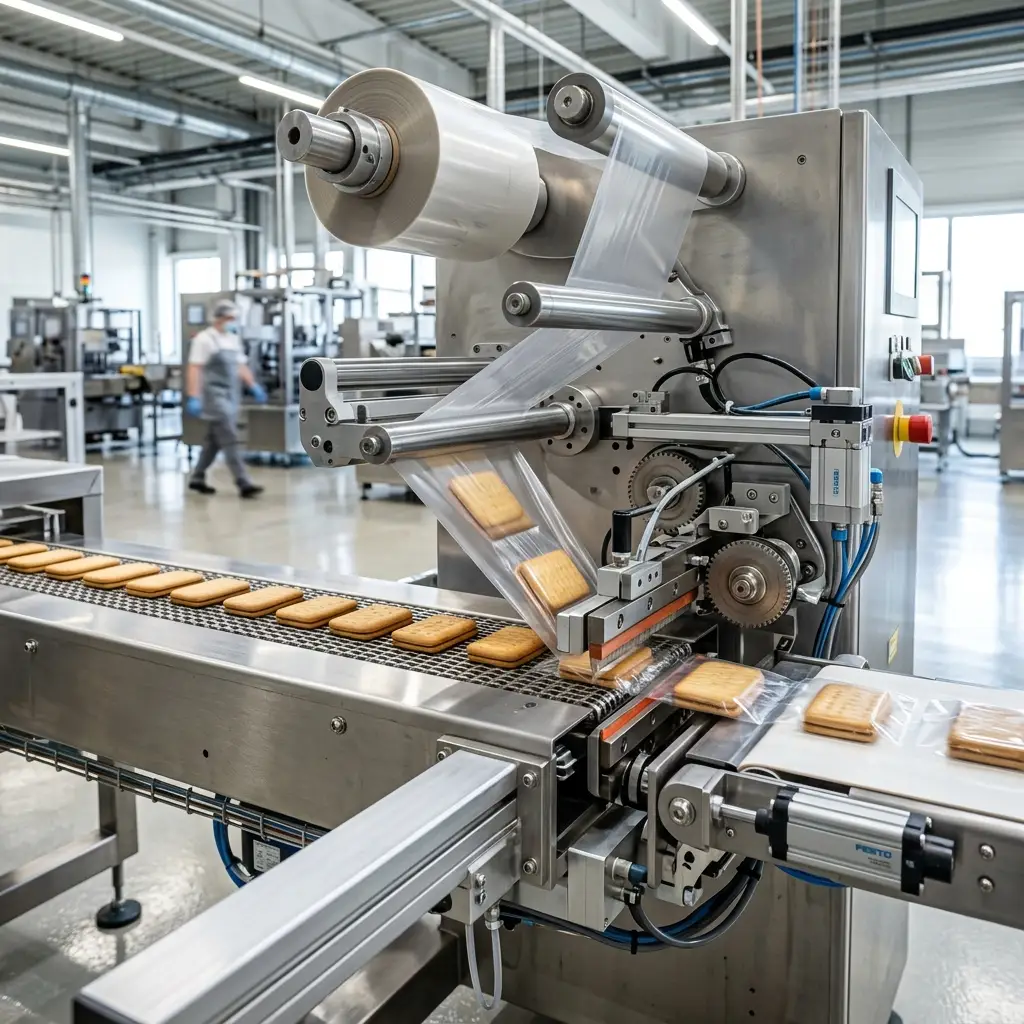
In an HFFS system, products are manually or automatically placed onto an extended horizontal in-feed conveyor belt at precisely spaced intervals. As the products travel down the line, a roll of packaging film is fed from below or above. A forming plow wraps the continuous web of film around the product horizontally, creating a loose tube.
Rotary or box-motion sealing jaws then simultaneously create the continuous fin-seal (running horizontally down the length of the package) and the end-seals (separating individual items). Because the product is fully supported by the conveyor belt and the base of the machine throughout the entire operation, it never undergoes a vertical drop.
Ideal Applications for HFFS
The defining characteristic of HFFS machinery is its gentle handling and precision wrapping of discrete, solid items. If dropping a product down a vertical tube would damage its structural integrity or ruin its physical presentation, an HFFS machine is strictly required. Standard applications include:
- Bakery & Confectionery: Biscuits, cookies, chocolate bars, bread loaves, and grouped baked goods.
- Personal Care: Bar soaps, individually wrapped wet wipes, and blister-packed pharmaceuticals.
- Hardware & Household: Scouring pads, individually wrapped sponges, electrical components, and grouped stationery items.
Engineering Advantages of WIDEWAYS HFFS
Horizontal systems demand extreme synchronicity between the in-feed conveyor speed and the rotary sealing jaws. A minor discrepancy results in the jaws cutting directly into the product, causing immense waste and machine fouling. WIDEWAYS utilizes highly calibrated servo-driven motors governed by Japanese precision electronics to guarantee that the cutting trajectory aligns perfectly within the millimeter tolerances of the film registration marks.
Head-to-Head Comparison: Space, Speed, and Operations
1. Factory Floor Space Utilization
Space is capital. Because VFFS machines process vertically, they boast a highly compact footprint. Factories can rapidly scale capabilities by parallel-installing multiple vertical units in a space that would historically only accommodate a single outdated line. Conversely, HFFS machines require significant linear floor space due to the extensive length of their in-feed and out-feed horizontal conveyor belts. If horizontal real estate is severely limited in your facility, VFFS is heavily prioritized.
2. Production Speed and Throughput
Both machine archetypes are capable of aggressively high outputs, routinely clearing hundreds of units per minute. However, speed is largely dictated by the product’s behavior. A VFFS operating alongside a multi-head weigh filler can drop and seal granules almost instantaneously. An HFFS is technically bounded by how rapidly solid items can be accurately indexed onto the in-feed conveyor without tumbling or crushing. For pure, high-volume granular throughput, vertical forms generally possess a higher operational ceiling.
3. Product Flexibility and Changeovers
VFFS machines traditionally offer incredible flexibility regarding product volume. Changing a 500g spice run to a 1kg spice run mostly involves adjusting the HMI software parameters and swapping the physical forming tube if bag width changes. HFFS machines excel at handling diverse item shapes. Changing an HFFS from wrapping a long bread loaf to a short biscuit tray requires adjusting the physical guide rails, in-feed pushers, and bag-length sensors, which requires a highly engineered Siemens PLC interface to minimize downtime.
Financial ROI: Bypassing LC Delays and Leveraging Local Inventory
The technical distinctions between vertical and horizontal architectures represent only half of the procurement equation. The more pressing B2B reality involves procurement speed. Acquiring premium industrial machines typically demands establishing a Letter of Credit (LC) for global imports. This deeply bureaucratic procedure freezes capital while waiting for foreign banks to clear transactions, ships to arrive from China or Europe, and port authorities to release the cargo.
WIDEWAYS Techserve obliterates this archaic procurement bottleneck. Rather than serving as an indenting broker, we act as a complete lifecycle, commercial turnkey partner. We maintain a substantial local inventory of sophisticated packaging systems right here in Dhaka. This strategy allows factory directors to execute machinery purchases entirely in Bangladeshi Taka (BDT). You eliminate the unpredictable fluctuations of foreign currency reserves, you circumvent banking delays, and you take delivery of equipment in days, not three to four quarters.
The speed to market achieved by bypassing LC imports generates immediate, measurable ROI. The months your local competitors spend waiting for a shipping container to arrive are the exact months your newly installed WIDEWAYS machinery spends fulfilling massive distributor orders.
The True Value of Local Engineering Accountability
Regardless of whether you integrate a VFFS or an HFFS system, machines operated in a strenuous 24/7 manufacturing environment will experience friction, wear, and eventual electronic faults. This is an inescapable law of industrial physics. The variable that determines financial success is the velocity of recovery.
The Foreign Specialist Trap
If you import a low-tier machine from Zengran or a premium one from Rovema, your factory is entirely dependent on their foreign technicians when critical failures occur. When a motherboard faults or a sealing jaw mechanically misaligns to the point of structural failure, remote video troubleshooting is vastly inadequate. You must book flights, arrange luxury accommodations, and endure visa processing times to fly a specialist into Bangladesh. Meanwhile, your production line is completely immobilized, raw materials are spoiling, and operators are standing idle. The hidden cost of “cheap” imports is catastrophic downtime.
The WIDEWAYS 24/7 Ecosystem
Our commitment extends far beyond the sale of iron and steel. WIDEWAYS Techserve provides absolute local engineering accountability. Operating from our Dhaka headquarters, we dispatch skilled Bangladeshi engineers—rigorously trained to international, German-equivalent standards—directly to your factory floor.
Because we maintain a vast, on-hand inventory of critical spare parts—including specialized heating cartridges, high-temperature Teflon pulling belts, and precision cutting blades—we can execute systemic repairs instantly. We ensure that our local engineers can resolve mechanical and software issues at 3:00 AM on a Friday, eliminating the anxiety of foreign reliance. Your production recovers in mere hours.
Answer Engine Optimization (AEO) Section
To further clarify the immediate distinctions and technical requirements of these packaging ecosystems, we have addressed the most urgent operational queries directed at our engineering department.
What is the main difference between VFFS and HFFS?
The primary difference is the directional flow of the product during the packaging process. VFFS (Vertical Form Fill Seal) systems utilize natural gravity to drop products downward into vertically formed pouches, making them the absolute best choice for powders, granules, and loose items. Conversely, HFFS (Horizontal Form Fill Seal) systems move products horizontally down a rigid conveyor belt, which is mandated for packaging solid, single, fragile, or individually portioned items like biscuits or soap.
How to reduce packaging downtime when switching formats?
To drastically reduce packaging downtime during product changeovers, procurement teams must invest in machines equipped with sophisticated Siemens PLCs or Beckhoff automation. These high-tier electronics allow operators to load pre-saved recipe parameters via the touch-screen Human-Machine Interface (HMI). This digital transition eliminates hours of manual mechanical recalibration, maintaining continuous high-volume output.
Why is a servo auger filler paired with a VFFS machine?
A servo auger filler is predominantly paired with a VFFS machine because non-free-flowing powders—such as turmeric, cumin, or wheat flour—cannot drop accurately via simple gravity. The servo auger uses a digitally controlled rotating screw to force an exact volume of sticky or dusty powder downward into the VFFS forming tube, executing perfect volumetric accuracy thousands of times an hour.
Case Scenarios & Decision Framework
If you are still weighing the capital expenditure, consider the following situational frameworks designed to guide procurement strategy:
- Scenario A: The Spice Manufacturer. Your facility produces highly dusty, non-free-flowing chili powder. Floor space is somewhat constrained, and output speed is critical to meet seasonal demand.
Decision: You exclusively require a VFFS Machine paired with a Servo Auger Filler. It provides the vertical space-saving architecture needed alongside absolute powder dosing precision. - Scenario B: The Bakery Conglomerate. You manufacture delicate wafer cookies that crumble easily. They must be packaged individually to supply local school distribution networks.
Decision: You absolutely require an HFFS Machine. Dropping a delicate wafer down a vertical tube will destroy it. The horizontal conveyor ensures gentle transport and secure wrapping. - Scenario C: The Rapid Scaler. Your FMCG brand just secured a massive contract with a nationwide supermarket chain. You need to triple your packaging capacity for lentils immediately, but your LC limit is currently exhausted by a separate raw-material import.
Decision: You require a WIDEWAYS VFFS Machine purchased locally in BDT. You circumvent the LC restrictions entirely, scaling capacity instantly to meet the contractual deadline.
Conclusion & Call to Action
The choice between Vertical Form Fill Seal and Horizontal Form Fill Seal architecture ultimately dictates the operational rhythm of your entire manufacturing facility. Whether your product demands the gravity-fed efficiency of vertical integration or the solid, stable handling of horizontal transport, deploying the correct system guarantees minimized waste and drastically enhanced ROI.
More importantly, selecting the right partner secures the lifespan of that investment. Stop fighting bureaucratic LC delays and surrendering your uptime to foreign technicians who are thousands of miles away. WIDEWAYS Engineering & Automation Ltd. delivers premium German and Japanese technological precision combined with unimpeachable, 24/7 local Bangladeshi accountability.
Do not let procurement delays stall your operational growth. Contact the WIDEWAYS Techserve corporate hotline today to book a free, comprehensive factory layout consultancy and secure your turnkey packaging solution.